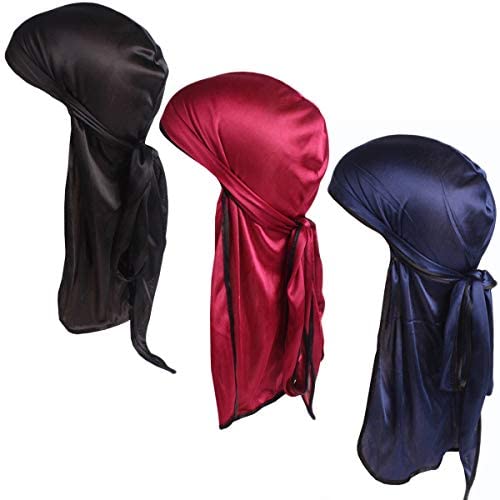
Do rag
A do-rag (alternate spellings), silky, or wave cap is a close-fitting cloth cap tied around the top of the head.Do-rags may be worn to accelerate the development of long curly/kinky hair, waves or locks in the hair to maintain natural oils in hair (similar to a bonnet); to stop hair breakage; or to keep hair, wave patterns and braids from shifting while sleeping. Do-rags are also worn as an identity-making fashion choice, popular in African-American culture.
History
Durag was first published in the June 1966 Akron Beacon Journal, then spelled “Do Rag”. There, it was described as “a cloth band worn around the forehead as a sweatband to keep hair in place”. They had evolved from the 19th-century when slave women used head wraps to keep their hair up and out of the way during labor. Companies like So Many Waves were credited for selling their version of the durag in the late 1970s, calling theirs the “Tie-down.” It became a necessary tool for Black men, used to train their curl patterns or to lock down hairstyles during sleep. The durag remained exclusively functional until the 1990s, when it started to become a symbol of inner-city Black culture. Years before the fashion industry took notice, it had become fashionable in the streets. The durag transitioned from a haircare item into a legit style accessory, most notably popularized by hip-hop and reflected on the heads of men and boys throughout the country. And originated from the United States in the 19th century.
Spelling of Durag
Numerous alternative spellings exist for durag, including do-rag, dew-rag, and doo-rag, all of which may be spelled with a space instead of a hyphen, or with neither a hyphen nor a space; especially as durag. The simplest etymology for do-rag is that it is named as such because it is a rag worn to protect one’s hairdo. However, The New York Times claims that the correct spelling of the word is durag. An alternative etymology claims that name should be spelt dew-rag, and dew is a euphemism for sweat
Controversies concerning the durag
Some United States high schools attempted to ban the wearing of durags.When John Muir High School in Pasadena, California, banned durags as part of a school dress-code policy, the Black Student Union staged a peaceful walk-out in February 2019. Protesting students contended that school administrators banned the head-wear because of its affiliation with gang culture, although the principal claimed that durags were banned because “of values we have for how we present ourselves at school”.
In 2001, the National Football League banned its players from wearing durags and bandanas underneath their helmets
Tips on How to Care For Your Durag
1. A clean durag is also good skincare, so avoid dirt and bacteria that can affect your skin.
2. Avoid sharing durags with other people.
3. Don’t put your durag in the washing machine.
4. Hand wash your durag with mild soap.
5. Occasionally use a little conditioner to keep the durag soft.
6. Rinse, gently squeeze excess water, air dry (never use a dryer).
7. Instead of tossing them in a drawer, hang durags on a hook to preserve freshness.
8. Keep an extra durag for when your hair isn’t as clean.
9. Know when it’s time to let it go (usually when the holes start).
10. For best haircare, invest in silk or satin durags (you can even have them custom made)
Olorunwa oluwapelumi
 RENARSA PRESS UI